An L4-L5 disc bulge means the soft cushion between the fourth and fifth bones of the lower back is extending past its usual edge. Dr. Nikhil Bhamare, a neurosurgeon and spine surgeon at Medinova Super Speciality Hospital in Nashik, reads this line on MRI reports every week. It can explain back pain and pain travelling into the leg. It is also found on scans of people who feel well. The sentence on the report is not, by itself, a decision for surgery.
Where L4 and L5 sit
The lower back is the lumbar spine. The bones are numbered from the top: L1, L2, L3, L4, and L5. A disc sits between each pair. The L4-L5 disc is the cushion between the fourth and fifth lumbar bones, just above the pelvis. It takes load when you sit, bend, lift, and twist, which is why this level shows up so often on scans.
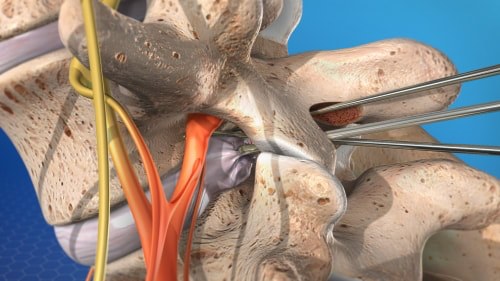
The disc has a tougher outer rim and a softer centre. With years of load, the rim can weaken and the disc can change shape. That change is what the radiologist is describing. Age, long hours of sitting, repeated lifting, and a previous strain can all be part of the story. None of those facts tells you, on their own, whether this disc is the cause of the pain you feel today.
What an L4-L5 disc bulge means on the report
A bulge means the disc margin has moved outward, usually across a wide part of its edge. A herniation, which many people call a slip disc, is a more focal push, sometimes with a piece of the softer centre coming through a weak spot in the rim. Reports use these words in slightly different ways. If your report says both “bulge” and “herniation,” bring it to the consultation so the pictures and the words can be read together.
A diffuse disc bulge means the extension is broad rather than a single sharp point. “Diffuse disc bulge at L4-L5” is a description of shape. Words such as mild, moderate, or severe describe how the radiologist saw the disc on that scan. They are not a score that decides treatment. A mild line can still irritate a nerve if it sits against the nerve in a tight space. A larger bulge can be painless if it is not touching a nerve and your examination is normal.
The useful question is whether the finding matches your symptoms and your examination. Dr. Bhamare looks at where the disc meets the nerve, whether the canal is tight, and whether the weakness or numbness on examination fits that level. The MRI is one part of that. It is not a diagnosis you should finish at home.
L4-L5 disc bulge symptoms
Some people have only a deep ache in the lower back, worse after sitting or bending, and easier when they walk a little. Others have pain that leaves the back and travels into the buttock and down one leg. Tingling, a heavy feeling, or a patch of reduced feeling can travel with that pain. The path depends on which nerve is irritated. Two people with an L4-L5 disc bulge can describe different legs, because the disc can press the nerve in more than one place.
Symptoms that often go with nerve irritation at this level include:
Pain in the lower back that spreads into one buttock or leg
Tingling or numbness in the leg or foot
A leg that feels weak, or a foot that slaps when you walk
Pain that increases with sitting, bending, coughing, or straining
Back stiffness alone, without leg symptoms, is often muscle or joint pain. It can exist next to a disc bulge that is not the main problem. That is why a scan ordered “just to see” can create worry. If the examination does not match the picture, the bulge may be a finding to know about, not the thing that needs an operation.
How an L5-S1 disc bulge is different
L5-S1 is the disc one level lower, between the last lumbar bone and the sacrum. An L5-S1 disc bulge is the same kind of finding in a different place. It is very common on the same MRI that mentions L4-L5. The nerve that can be irritated is not always the same nerve, so the pain and the numb patch can sit in a different part of the leg or foot.
Seeing both lines does not mean you have two separate diseases, and it does not mean you need two operations. It means the lower two discs have changed shape. The consultation is about which level, if either, matches the pain, the weakness, and the day-to-day limit you have. Treating the wrong level helps no one.
L4-L5 disc bulge treatment
For many people, the first treatment is time, simpler activity, and a plan that protects the nerve while it settles. Short rest from heavy lifting is reasonable. Days spent lying flat usually make the back stiffer and do not fix the disc. Walking, as pain allows, is the activity most people can start with.
A doctor may also use pain relief for a limited time, and a physiotherapist may guide movement once it is safe to do so. Some people are offered an injection around the nerve if leg pain is severe and the examination fits the scan. That is a clinical decision made after you are seen. It is not a step to arrange from a report alone.
Surgery is discussed when the nerve problem is clear, simpler care has not helped, or there is weakness that is getting worse. The operation, when it is the right operation, is aimed at taking pressure off the nerve. It does not return the disc to the way it was at age twenty. Read more about how a slipped disc is assessed on the slip disc page.
No one can promise that a bulge will vanish from the next MRI, or that an operation will remove every trace of numbness. Nerves recover on their own timetable. The aim of care is less pain, safer walking, and a plan that matches the problem in front of you.
L4-L5 disc bulge exercises
Exercises help many people, and the wrong exercise can flare a nerve. A physiotherapist who has examined you should choose the routine. A video made for a different person is not a prescription.
What is generally sensible, unless you have been told otherwise:
Walk on flat ground for short periods, and stop if the leg pain or weakness increases
Change position often if your work is a desk
Avoid lifting from a bent, twisted waist while the leg pain is active
Keep the movements that ease you, and pause the ones that send a sharp pain down the leg
Core work, stretches, and back-bending exercises are not automatically safe or unsafe. Some people feel better with one and worse with the other. If an exercise increases numbness, weakness, or pain below the knee, stop that exercise and tell the person treating you. Do not push through a new foot drop or a leg that is giving way.
When to stay home, when to book, and when to go to emergency care
Stay home for now
A familiar lower-back ache after a known strain, with no new weakness, no trouble passing urine, and no numbness spreading into the saddle area, can be watched for a few days. Ease the lifting. Keep short walks. If the pain is clearly settling and you can manage your usual light day, you do not need to rush into a scan.
Book a visit
Book if leg pain is not settling, if numbness is spreading, if the leg feels weak, or if you have an MRI line you want explained against your symptoms. You can request a consultation at Medinova Super Speciality Hospital, Shatabdi Hospital Unit, Nashik. The hospital phone is +91 88888 86272. Bring the MRI films or the disc, and the written report, so the pictures can be seen rather than only the words.
Go to emergency care
Go to emergency care the same day if you cannot pass urine, if you lose control of bladder or bowel, if numbness appears in the inner thighs, genitals, or around the anus, or if both legs are becoming weak quickly. The same applies after a serious fall or road accident with new back pain and leg symptoms. These are signs of pressure on the nerves at the bottom of the spinal canal. They are not a problem to watch overnight at home. Emergency neuro trauma evaluation is available at the hospital.
Questions people ask
Is an L4-L5 disc bulge the same as a slip disc?
Not always. A bulge is a broad change in the disc’s edge. A slip disc, or herniation, is usually a more local push of disc material. Both can irritate a nerve, and a report can mention either word at L4-L5. The examination decides whether that line is the cause of your pain.
Does a diffuse disc bulge mean the disc has collapsed?
No. Diffuse describes a wide, shallow extension of the disc edge. The disc can still have height. Collapse, dehydration, and bulge are separate comments a radiologist may make. Ask for them to be translated into what they mean for your nerve, not only what they look like on the film.
Will I need an operation?
Most people with this finding are treated without an operation first. An operation is considered when pain and nerve findings match the scan and are not settling, or when weakness or the emergency symptoms above are present. A bulge on a report is not an instruction to operate.
Can I keep working?
Many people with desk work can continue if they stand and walk at intervals and the leg is not getting weaker. Heavy lifting, driving for long stretches, and work that needs a sudden twist should wait until you have been advised. If the leg gives way or you cannot feel the pedals safely, do not drive.
Should I repeat the MRI every month?
No. A repeat scan is useful if the symptoms change in a way that suggests a new problem, or if an operation is being planned and the pictures are old. Repeating a scan because the words are worrying, while you are improving and the examination is stable, rarely changes the plan.
Related doctor
Doctor mentioned in this article — open a profile to learn more or book a visit.
- DR
Dr. Nikhil Bhamare
Neurosurgeon & Spine Surgeon
Related treatments
Clinical programmes and treatments connected to this topic.
Related articles

Minimally Invasive and Endoscopic Spine Surgery: What Patients Should Know
Smaller incisions, less muscle disruption, and faster recovery are possible for many disc and stenosis cases — but candidacy and expectations matter.
Read article
Stroke Warning Signs: When Every Minute Matters
Stroke destroys brain tissue quickly — recognising FAST signs and calling emergency services immediately can save lives and reduce disability.
Read article
Understanding Awake Craniotomy for Brain Tumors
Awake brain surgery allows real-time testing of speech and movement while a tumor is removed — improving safety when the lesion sits near critical brain areas.
Read article